THE SON'S ROOM (Nanni Moretti)
A psychoanalyst (Nanni Moretti), accustomed to ordering the pain of others through speech and reason, confronts a loss that completely disarms his tools: the death of his son. The Son’s Room does not narrate mourning as catharsis, but as suspension: a time in which meaning does not arrive, and language fails. Amid guilt, silence, and the impossibility of understanding, the film observes how a family discovers that even the closest love was crossed by unknown zones. Mourning is not resolved: it is inhabited.
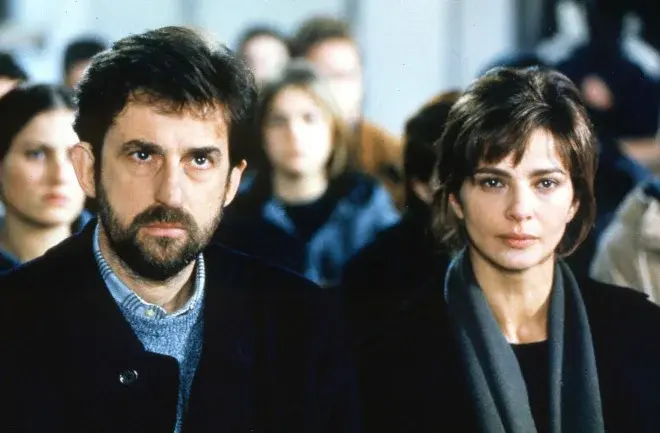
Nanni Moretti’s performance is always slightly displaced. Giovanni seems to exist halfway between life and its interpretation, as if he never fully settles into the reality he inhabits. He does not react with visible intensity; he observes, analyzes, and organizes. Even before the tragedy, there is in him a distance difficult to name, a tendency to understand before feeling. Thought seems to arrive first, as if understanding were a silent way of keeping himself safe.
The death of his son does not introduce a new fracture; rather, it makes visible one that was already there. What functioned in everyday life — the ability to order, explain, and accompany others — ceases to operate when pain no longer belongs to the field of what can be interpreted. The psychoanalyst, accustomed to sustaining the words of others, is left without a place from which to sustain his own experience.
One of the most revealing scenes takes place at the fair. Surrounded by stimuli designed to provoke emotion — lights, noise, constant movement — Giovanni walks searching for something that might reach him. He investigates the accident as if the accumulation of data could alter the weight of the loss. The world insists on offering sensations, but nothing manages to penetrate him. There is no emotional outburst nor belated revelation: only the persistence of a distance that now becomes unbearable.
The film thus exposes the limits of psychological knowledge. Not as a critique of psychoanalysis, but as a recognition of its boundary: there are experiences that cannot be thought without remainder. Each character then attempts to continue with the resources they possess, always insufficient, always partial.
Some patients find relief in minimal gestures after their sessions; Giovanni, by contrast, loses even that place from which he helped others. The question is no longer how to interpret pain, but how to continue inhabiting time when the everyday structure has ceased to sustain it.
Father and mother (Laura Morante) also discover, too late, that they knew only fragments of their son. The identity of the absent one begins to be reconstructed through others’ accounts, incomplete memories, and gazes arriving from outside. There is no direct access to the past, only mediations. Mourning thus appears as a necessarily incomplete experience: to love someone also implies accepting how much remains unknown.
Giovanni remains fixed to a temporality that does not fully move forward. He searches for causes, reviews decisions, imagines possible variations of the past, as if a minimal modification could alter the present. But the film never turns this search into a learning or a moment of redemption. Silence settles in as a form of resistance and, at the same time, as a symptom. His wife expresses it with painful clarity:
“You never want to talk to anyone, you think you will lose something if you speak with others. I feel sorry for you.”
Not speaking does not protect. It only delineates the wound's contour.
Moretti avoids any form of narrative consolation. There is no final revelation nor evident transformation. Pain does not produce wisdom nor immediate reconciliation; it simply modifies one’s relation to the world. Life continues, but no longer with the illusion of stability that once seemed natural.
The Son’s Room remains in that uncomfortable space where thought does not suffice and emotion finds no clear form of expression. Mourning does not appear as a process leading to overcoming, but as a presence that slowly integrates into existence, without ever being fully resolved.
In the end, what remains is not a lesson, but a more discreet and persistent sensation: understanding was never enough, and perhaps never will be. Time continues to move forward, even though something — irreparable — has remained suspended within it.
La stanza del figlio (Nanni Moretti, 2001)