AFTERSUN (Charlotte Wells)
Father and daughter on vacation. But what we see is not exactly that trip, but rather the memory of it. That distance traverses the entire film: adult Sophie trying to reconstruct something that happened when she was eleven.
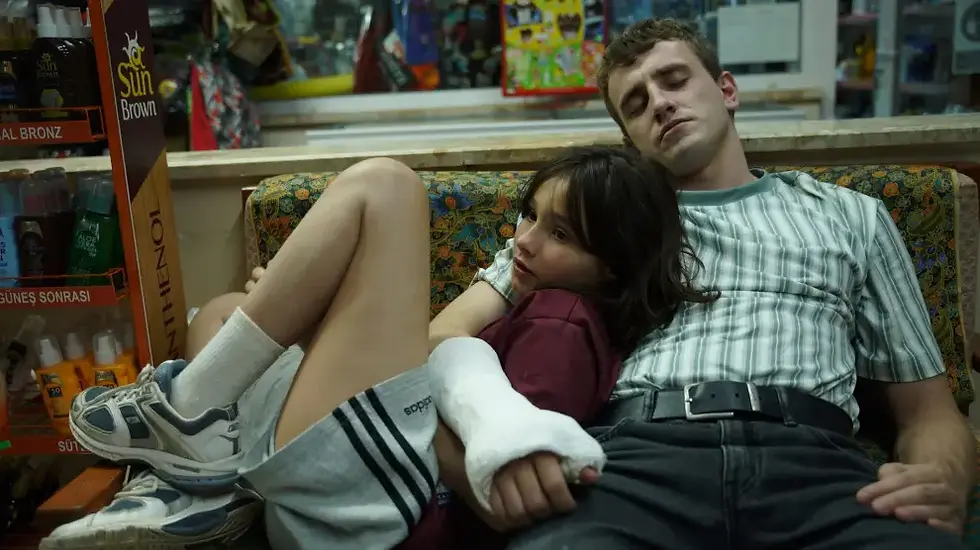
We don’t see the past directly. We see what remains of it.
There is a very particular complicity between them. They love each other, play, and seek each other out. Yet something in the relationship is slightly off. It is not the traditional father-daughter relationship. At several moments, they seem more like siblings: two ages that don’t quite fit in the place they are supposed to occupy.
Sophie (Frankie Corio) is entering puberty. She begins to notice others, observe older girls, and approach the first gestures of desire with curiosity. The film accompanies that awakening with a camera very sensitive to surfaces: swimming bodies, skin, reflections on water.
It is not explicit sexuality. It is something more diffuse, more tactile. As if the world were beginning to feel differently.
Meanwhile, Calum (Paul Mescal) — the father — seems to move in the opposite direction. He is thirty-one, yet something in him still belongs to adolescence. He loves his daughter and tries to be a good father, but there is a deep difficulty in sustaining the adult role.
He is close, affectionate, even playful. But he is also a father without much authority.
Today, we might call him a modern father: more horizontal, more friend than authority figure. Yet the film hints at something more unsettling than that simple update of the paternal role. There is in him a certain lack of anchoring, as if he does not quite know where to place himself in the world.
At times, Sophie seems emotionally steadier than he is.
It is never stated explicitly, but everything in Calum suggests a sadness difficult to name. Small gestures give him away: the way he lingers alone on the balcony at night; the silence that falls when Sophie falls asleep; the moment he cries with no one watching.
As if trying to protect her from something, he can no longer sustain himself.
At this point, the film begins to suggest a deeper dimension: Calum’s relationship with his own ideal of manhood. Masculinity appears not as a secure identity, but as an expectation hard to reach.
Society still demands certain concrete things from the adult man: stability, emotional control, the ability to provide and sustain a family. Calum does not entirely fit that framework. His life suggests a certain precariousness, a lack of economic and existential stability that distances him from the traditional ideal of the provider father.
Not necessarily because Sophie perceives it that way, but because he measures himself against that ideal.
The pressure of this model also manifests psychologically. Masculinity in our turbo-capitalist society demands productivity, strength, self-control, and a certain emotional opacity. Showing vulnerability falls outside that frame. Calum seems to live precisely in that ideological tension: attempting to maintain a light, playful, protective image for his daughter, while something inside him collapses.
Sadness is present, but rarely finds a place to express itself.
A seemingly banal scene condenses this ambiguity. Someone comments that they look like siblings. Normally, this phrase works as a physical compliment for the father and a small offense for the daughter. But here, it resonates differently.
Because, in a way, it is true.
Calum seems to have prolonged his adolescence too long. And Sophie, in contrast, begins to move toward an emotional maturity that is not yet fully hers.
Both are on a threshold.
That misalignment produces in the film a constant sense of limbo.
A limbo that appears literally in the rave scenes. A dark space full of strobe lights where adult Sophie tries to reach her father among the crowd. Time seems suspended there. Bodies appear and disappear in flashes. Calum is never fully visible, only in fragments.
It is not a space of celebration or hedonism. Rather, it functions as a place of dissolution.
In that space, identities become unstable, bodies merge, and figures appear and disappear. The rave becomes an image of escape: not a place to enjoy, but a place to vanish, to temporarily withdraw from the world’s expectations.
The impossibility of facing those demands — being an adult, being a father, being the man one is supposed to be — seems to find its symbolic form there.

Home videos appear constantly throughout the film. The video camera with which Calum records small moments: conversations, games, and daily gestures. They are not spectacular images. They are clumsy, unstable, like any family archive.
But precisely because of that, they acquire another intensity.
Because those images survive. And what survives always ends up carrying more weight than it had when it was recorded.
The entire journey thus becomes a retroactive question.
The memories are few: a hotel in Turkey, a few excursions, karaoke, and the video recordings. Nothing particularly extraordinary.
But precisely for that reason, those memories expand, like dampness on a wall. They try to occupy the space of what was never fully known.
In the midst of all this appears the scene that seems to concentrate that contained emotion: dancing to “Under Pressure,” by Queen and David Bowie.
Calum insists they dance. Sophie resists at first, then joins the floor. The song begins almost as a game, but gradually something changes. There is a strange intensity in the moment, as if both feel something they cannot yet name.
For a few seconds, it seems everything aligns.
But the scene also carries a sense of farewell.
Perhaps because adult Sophie remembers it that way. Perhaps that trip was one of the last moments when her father could truly be present. The film never states it clearly, but the feeling that remains is that Sophie tries to reconcile two images that don’t quite fit: the joyful father dancing with her, and the man likely falling into a darker place.
The ending reinforces that impression.
Calum is filming with the video camera. He finishes, pauses for a few seconds, then turns around. He walks down the hotel hallway and opens a door from which the intermittent rave light bursts in.
The camera, however, leaves us at the airport.
Calum disappears into that fragmented light.
It is a simple gesture, but devastating. As if memory reaches that point and cannot move further.
As if remembrance hits a boundary.
Perhaps that is why the film feels so painful. Because adult Sophie is trying to reconstruct not only a summer, but a much harder question: who her father really was, and what he was living while she could not yet understand.
Cinema here functions as a second gaze. A gaze that arrives too late.
But that gaze still insists on returning to the same images again and again, trying to find in them something we could not see before.
Perhaps in that gesture — revisiting memories, seeing them from another place — there is also a form of mourning.
Not to close the story.
But to continue inhabiting it.
Aftersun (Charlotte Wells, 2022)